

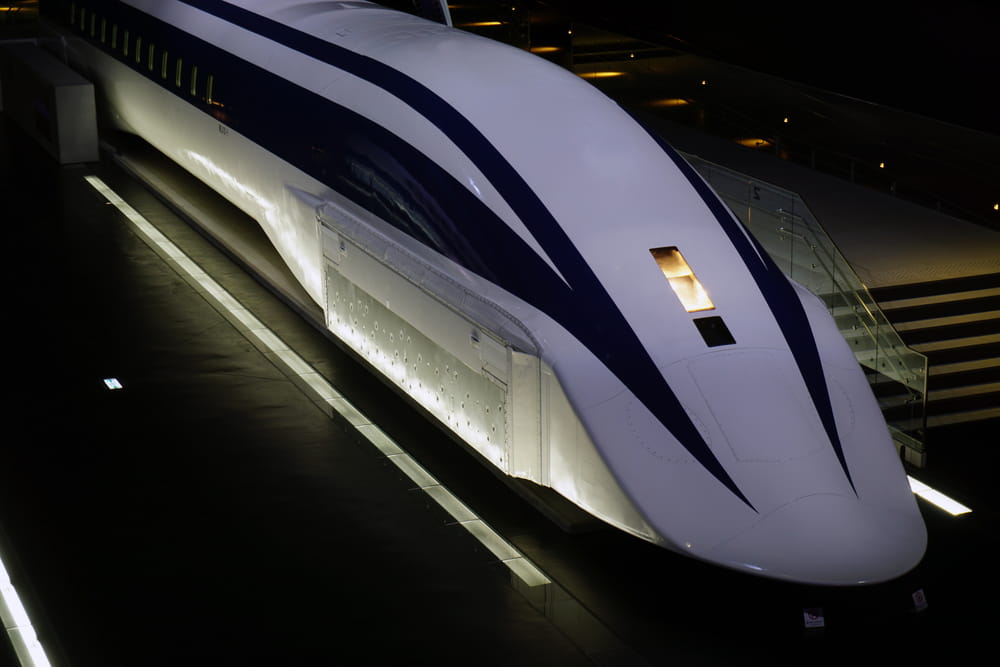
Japan is developing the world’s fastest train, the L0 Series maglev, which is expected to reach speeds of up to 603.5km/h, far faster than any commercial train currently in service. The magnetic-levitation train is being built by JR Central as part of the new Chūō Shinkansen line.
By comparison, Europe’s fastest operational trains – such as France’s TGV and Italy’s Italo – typically run at 300–350km/h, while China’s Shanghai Maglev tops out at about 460km/h.
Dramatically shorter journey times
The L0 Series is designed to cut travel time between Tokyo and Nagoya to around 40 minutes, down from more than an hour on today’s fastest services. Once extended to Osaka, the line would connect Japan’s three biggest cities in about one hour, effectively creating a single mega-region.
For comparison, a similar system in the UK could reduce a London–Edinburgh journey to roughly one hour, compared with nearly five hours today.
Why it’s so fast
The train uses magnetic levitation, lifting it above the track to eliminate friction. Electric motors and magnetic forces propel it forward, allowing it to “float” at extremely high speeds.
Cost, delays, and challenges
The project has already cost around £52bn (€60bn) and has been delayed from its original 2027 target. Current estimates suggest it will not open until 2034–2035.
Could Europe adopt it?
Bringing such a train to Europe would be difficult. Maglev systems require entirely new infrastructure, including long, specially dug tunnels, and cannot run on existing rail lines. They are also energy-intensive, expensive to build, and carry fewer passengers than conventional high-speed trains.
In addition, European rail travel often prioritises comfort, scenery and capacity, rather than ultra-fast point-to-point journeys. Outside of purely business-focused routes such as London–Paris or London–Brussels, an extreme high-speed system like the L0 Series may struggle to justify its cost.
For now, Japan looks set to lead the maglev future – while Europe watches from a distance.
